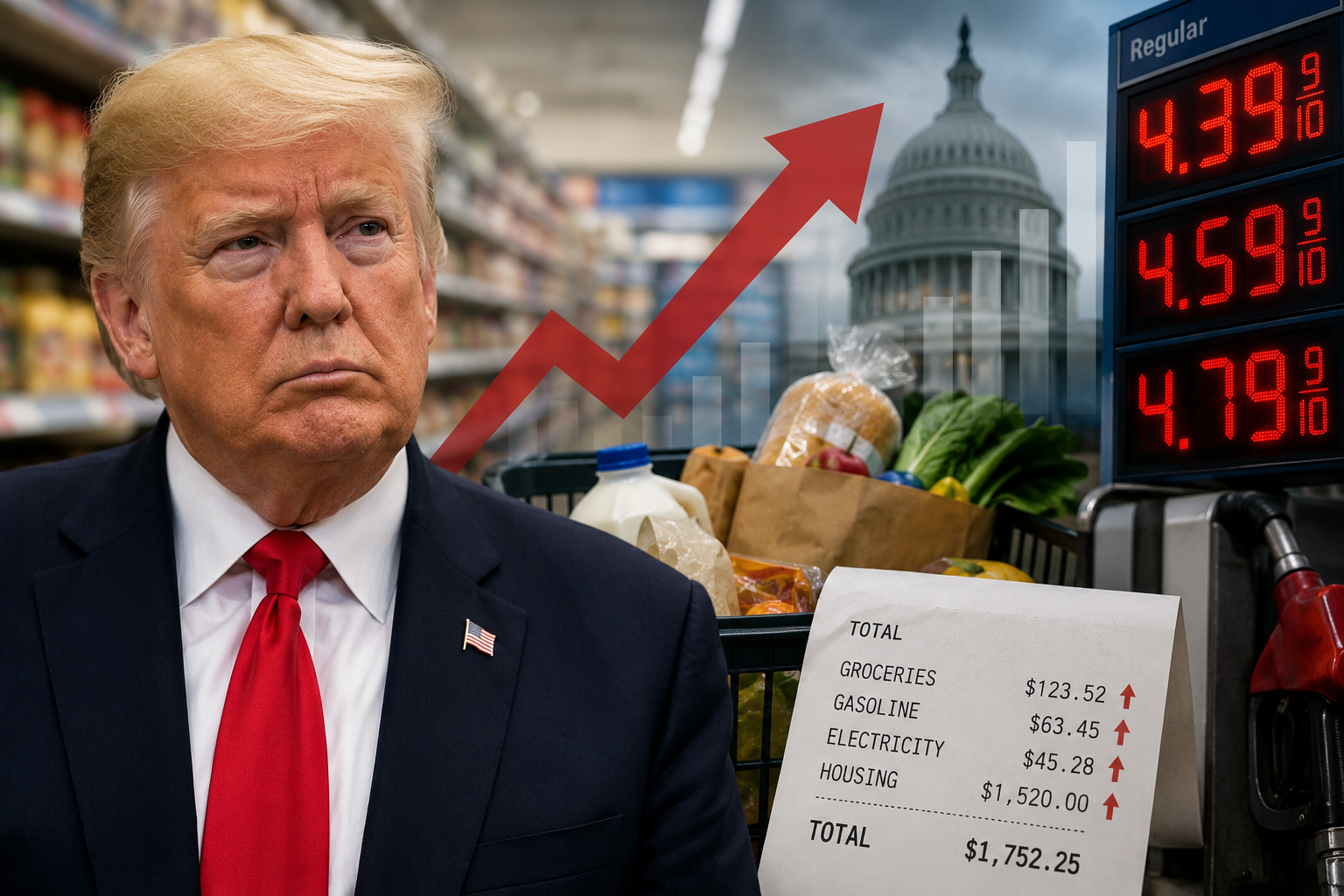
President Donald Trump returned to office promising that Americans would feel relief from high prices.
But with the 2026 midterms approaching, voters are still telling pollsters that affordability is a major problem — and Republicans are increasingly paying a political price for it.
A Reuters/Ipsos poll published this week found that 36% of registered voters believe Democrats have the better approach to the cost of living, compared with 28% who favor Republicans. That eight-point Democratic advantage is the party’s largest on the issue in Reuters/Ipsos polling since October 2025.
That does not mean voters suddenly trust Democrats broadly on the economy. In fact, 37% in the same poll said either that neither party had a good plan or that they were unsure. But the trend matters because affordability is exactly the kind of issue that can shape a midterm election: it is immediate, personal and difficult for an incumbent party to explain away.
The question for Republicans is becoming less about whether inflation has improved from its worst levels and more about whether voters actually feel better off.
The inflation rate is lower than the peak — but prices are still rising
One of the biggest political challenges in any inflation debate is that slowing inflation does not mean prices go back down.
The Consumer Price Index rose 3.4% over the 12 months through July, according to the Bureau of Labor Statistics. Food prices were up 3.0%, shelter costs were up 3.2%, electricity was up 4.2% and gasoline prices were 24.6% higher than a year earlier.
Those numbers help explain why affordability can remain politically toxic even when headline inflation is no longer at crisis-era levels.
Voters experience prices in dollars, not percentages.
A family paying more for groceries, rent, utilities or a weekly tank of gas may not feel much relief from being told that inflation is slower than before. And gasoline is especially politically visible because consumers see the price every time they drive past a station.
That problem has become more acute this summer. Reuters reported that Trump is meeting with refiners and fuel retailers as gasoline prices above $4 a gallon add pressure ahead of the midterms, with the Iran conflict contributing to higher energy costs.
Why this is dangerous for Republicans
Midterms are often referendums on the party in power.
That makes economic frustration particularly damaging for Republicans because they control the White House and are trying to defend their congressional majorities.
Earlier this month, another Reuters/Ipsos poll found Democrats narrowly ahead of Republicans, 37% to 36%, on which party voters trusted more to manage the economy. It was the first Democratic advantage on that question in roughly a decade of Reuters/Ipsos polling. In the same survey, Democrats led 42% to 37% on the generic congressional ballot.
Trump’s own approval rating has also weakened. Reuters/Ipsos reported last week that it had fallen to 33%, the lowest of his presidency.
None of those numbers guarantees a Democratic wave.
Republicans still hold advantages with some voters on immigration and crime, and the political environment can move quickly. But affordability is a particularly difficult weakness because it cuts across ideological lines.
A voter does not have to follow economic policy closely to know whether the grocery bill, electric bill or mortgage payment feels manageable.
The economy is not simply collapsing
There is an important distinction between political perception and the underlying economic data.
Personal income rose 0.4% in July, disposable personal income increased 0.5%, and consumer spending rose 0.2%, according to the Bureau of Economic Analysis.
So this is not a straightforward recession story.
The problem is that inflation is still running above the Federal Reserve’s long-term goal. The Fed’s preferred PCE price index was up 3.7% over the year through July, while the core measure excluding food and energy was up 3.3%.
That creates a politically awkward combination: the economy can continue growing while voters still feel squeezed by prices.
It also limits how quickly monetary policy can come to the rescue. Federal Reserve officials gathering at Jackson Hole this week have continued to warn about persistent inflation, with some openly discussing the possibility that interest rates may need to remain high or even rise further.
For households, that matters because higher rates affect mortgages, credit cards, auto loans and business borrowing.
Trump’s biggest problem may be expectations
Trump made affordability central to his 2024 campaign.
Reuters recently noted that his grocery-focused campaign messaging is now being turned back on Republicans as food prices continue to rise.
That creates a problem of expectations.
Voters often judge presidents not just against the alternative party, but against what the president promised.
If Trump had simply inherited high prices without making aggressive promises to reduce them, the political damage might be easier to contain.
Instead, Republicans now have to explain why many everyday costs remain elevated nearly two years after voters gave them control of Washington.
What could still change before November
The affordability picture is not fixed.
There are several plausible ways the politics could shift.
Gasoline prices could fall if energy markets stabilize. Inflation could continue to cool. Real incomes could rise faster than prices. The Federal Reserve could eventually become more comfortable easing interest rates. Any of those developments could improve consumer sentiment and give Republicans a stronger economic message.
But the opposite is also possible.
If the Iran conflict keeps energy prices high, if tariffs or supply disruptions push up goods prices, or if housing costs remain stubborn, Democrats will have an easy line of attack: Republicans promised lower costs and failed to deliver.
That is why the next two months of economic data may matter almost as much politically as they do financially.
The real midterm consequence
The cost-of-living fight is becoming a test of whether Republicans can convince voters that conditions are improving fast enough to justify keeping them in power.
Democrats do not necessarily need voters to believe they have solved the affordability problem. They may only need enough Americans to conclude that Republicans have not.
That distinction is important.
With control of the House and Senate at stake, even a modest shift among suburban, working-class and lower-propensity voters could matter in competitive districts and states.
For Trump and congressional Republicans, the political task is therefore straightforward but difficult: they need measurable economic improvement to become visible in household budgets before Election Day.
If that does not happen, affordability could become the issue that turns a complicated midterm environment into a much simpler voter judgment:
Are things cheaper — or at least easier to afford — than they were when Republicans took power?
Right now, the polling suggests too many voters are answering no.