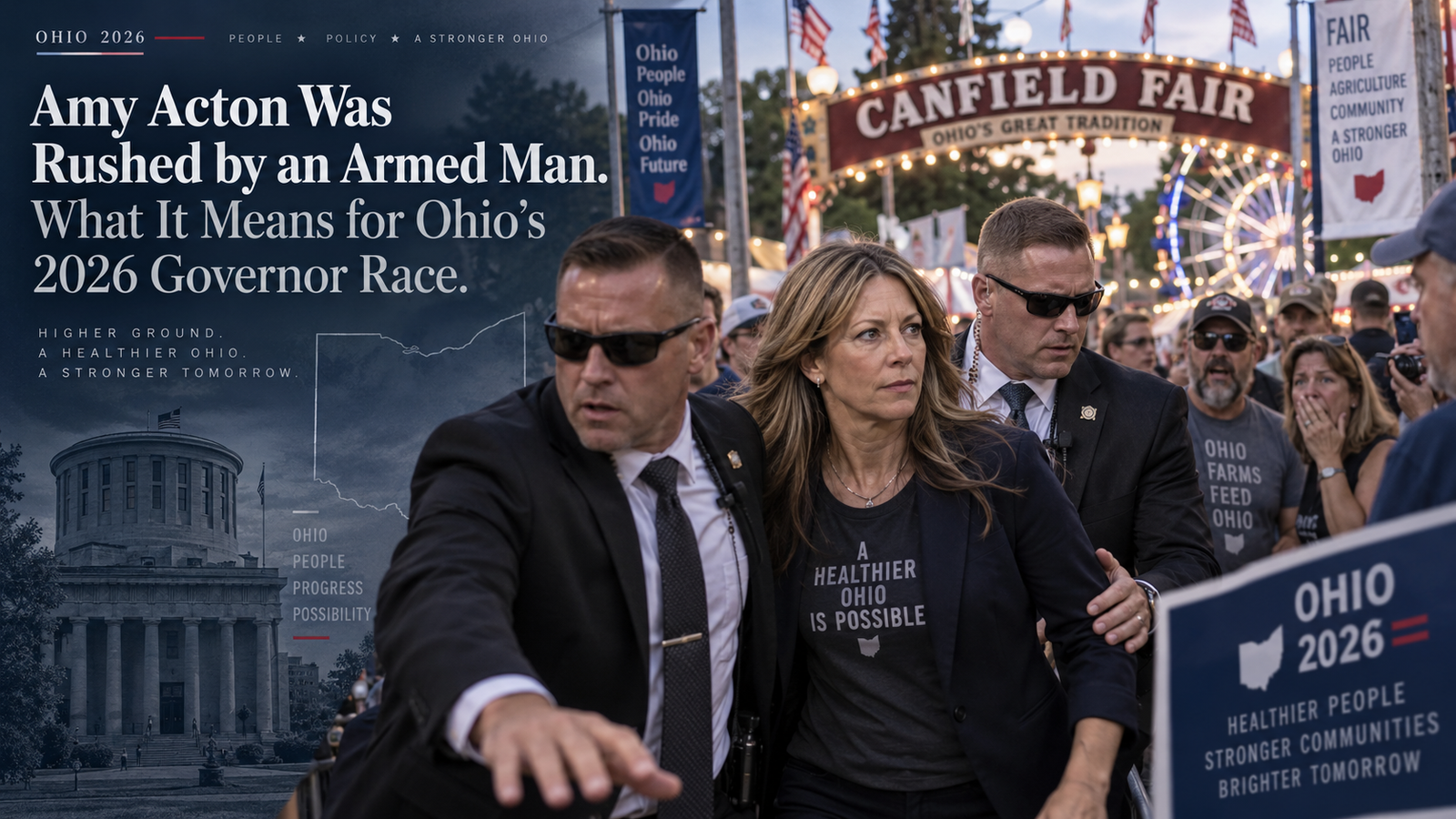
Amy Acton was campaigning at the Canfield Fair on Sunday when an armed man allegedly charged toward her through the crowd.
The Democratic nominee for Ohio governor was not injured. But several people were knocked down or hurt before law enforcement stopped the man, according to the Ohio State Highway Patrol. The suspect, identified as 38-year-old Patrick Havas, was carrying two pistols, a Taser and brass knuckles, though authorities said the weapons were not drawn. He was arrested and charged with disorderly conduct and two counts of assault.
The motive remains under investigation.
That uncertainty matters. There is no confirmed basis yet to describe the incident as a politically motivated assassination attempt, and ReadVONK should not imply one.
But the episode still has immediate political consequences.
Acton is running against Republican Vivek Ramaswamy in one of the most closely watched governor races of 2026. The attack places candidate security, political intimidation and the broader climate of political violence directly into the Ohio campaign at a moment when the midterm election is entering its final stretch.
What happened at the Canfield Fair
According to law enforcement, Havas moved aggressively through the crowd toward Acton during her campaign stop at the Canfield Fair near Youngstown.
Several people were injured as he allegedly knocked them over. Troopers stopped him before he reached Acton. She was unharmed.
Authorities later said Havas had two pistols, a Taser and brass knuckles in his possession.
He faces disorderly conduct and assault charges, and investigators are still examining why he moved toward Acton.
That last point is crucial.
The presence of weapons makes the incident serious. But because law enforcement has not established motive, the responsible description is straightforward: an armed man charged toward Acton and injured people in the crowd before being stopped.
Anything beyond that remains unconfirmed.
The reaction crossed party lines
The response was immediate.
Republican Gov. Mike DeWine condemned the incident. So did Acton’s Republican opponent, Vivek Ramaswamy, whose campaign said political violence and threats against candidates are unacceptable. Acton’s campaign likewise said violence has no place in Ohio politics.
That bipartisan reaction is politically significant because both campaigns have an incentive to prevent the race from turning into a debate over whether one side is responsible for an incident whose motive is still unknown.
For now, the most defensible political reading is not partisan blame.
It is that candidate security has suddenly become part of the Ohio governor race.
Why this matters for Amy Acton
Acton was already one of the more unusual Democratic candidates running statewide this year.
A physician and former director of the Ohio Department of Health, she became nationally known during the COVID-19 pandemic. Her public-health role also made her a target of intense political backlash over pandemic restrictions.
Now she is seeking the governorship in a state that has trended Republican in recent federal elections.
The incident at Canfield Fair could increase her visibility nationally and in Ohio. It may also create sympathy among some voters.
But that is analysis, not a demonstrated electoral effect.
There is no reliable evidence yet that the episode will move polls, turnout or fundraising.
The more immediate consequence is operational: Acton’s campaign and probably other Ohio campaigns will have to reassess security at public events.
Candidate security is becoming a bigger campaign expense
The incident also fits into a broader trend.
AP reports that federal political committees spent more than $40 million on security during the 2023-24 election cycle, reflecting growing concern about threats against candidates and public officials.
That number does not mean political violence is inevitable or that every threat is partisan.
It does show that campaigns increasingly treat security as a serious operating cost.
For candidates whose strategy depends on fairs, parades, town halls and other open public events, that creates a difficult tradeoff.
Retail politics works because candidates are accessible.
Security works by limiting access.
The more campaigns believe candidates are vulnerable, the harder it becomes to preserve the kind of direct voter contact that is especially important in statewide races.
Could the incident change the Acton-Ramaswamy race?
Possibly, but there are several different ways it could develop.
Scenario one: the electoral impact is limited
This is the most cautious assumption.
The incident receives several days of attention, campaign security increases, and the race quickly returns to issues such as the economy, abortion, healthcare, education and state government.
If investigators find no political motive, the story may fade relatively quickly.
Scenario two: Acton receives a visibility boost
Acton could receive increased media attention and sympathy simply because she was the target of a frightening public incident.
That does not automatically translate into votes.
But in a close statewide race, more attention can affect fundraising, name recognition and enthusiasm.
Evidence for this scenario would include a noticeable increase in Acton fundraising, national media appearances or polling movement following the incident.
Scenario three: security and political violence become campaign issues
If investigators uncover a political motive — or if additional threats occur against candidates elsewhere — the Canfield Fair episode could become part of a broader national argument about political violence.
That would be a much larger story.
At present, however, the evidence does not support that conclusion.
Why Ohio itself matters
The Ohio governor race is worth watching even without this incident.
Ramaswamy brings national name recognition from his presidential campaign and close alignment with the Trump movement.
Acton brings a very different profile: physician, former public-health official and Democrat seeking to win statewide in a state Republicans have increasingly dominated.
Whoever wins will inherit one of the country’s largest and most politically consequential states.
And if Acton wins, Democrats would likely study her campaign closely for evidence that they can still rebuild statewide support in parts of the industrial Midwest.
That could make her relevant well beyond Ohio.
The larger 2026 lesson
The most important consequence of Sunday’s incident may have little to do with polling.
American candidates are expected to walk through crowds, attend fairs, shake hands and make themselves physically accessible to voters.
The Acton incident illustrates the vulnerability built into that model.
Campaigns now have to balance two competing demands: remain accessible enough to connect with voters while protecting candidates against threats that may be difficult to predict.
For Amy Acton, that challenge became real in a matter of seconds at an Ohio fair.
Whether it changes the governor race remains unknown.
Whether campaigns will take candidate security even more seriously after it is much easier to predict.