The cryptocurrency industry has spent years building political power in Washington.
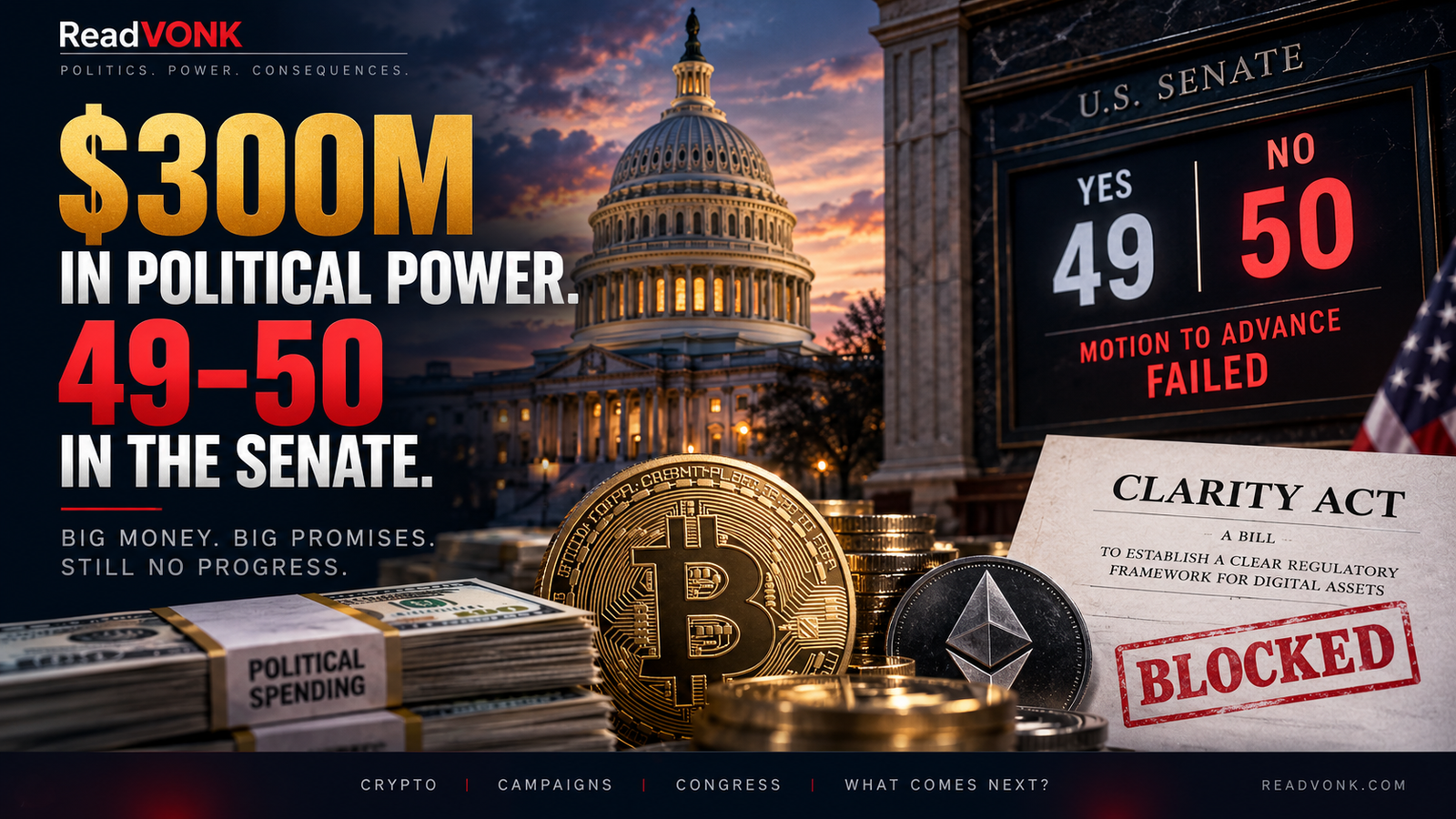
Crypto companies, executives and political groups have poured more than $300 million into U.S. elections, backing candidates and building an increasingly sophisticated political operation.
Then the Senate delivered a reminder that campaign money and legislative power are not the same thing.
On September 15, senators voted 49–50 against advancing the Digital Asset Market Clarity Act, or CLARITY Act. The procedural vote required 60 votes to move forward. Instead, the industry’s biggest legislative push stalled on the Senate floor.
The result raises an uncomfortable question for one of Washington’s newest political power centers:
What exactly did more than $300 million buy?
Crypto built a political machine
Few industries have increased their political spending as dramatically as crypto.
After years of battles with regulators, crypto companies increasingly turned to elections as a way to shape the people writing the rules. Industry-backed groups supported candidates from both parties and sought to make opposition to crypto politically expensive.
Reuters reports that the industry has now spent more than $300 million on U.S. elections, helping turn digital assets from a relatively specialized financial issue into a significant Washington lobbying force.
That money has clearly bought attention.
What it did not buy Tuesday was 60 Senate votes.
The CLARITY Act vote showed that an industry can become a major political spender without gaining automatic control over legislation.
What the CLARITY Act would do
The legislation is intended to establish a broader federal framework for digital assets, including clearer boundaries between the Securities and Exchange Commission and the Commodity Futures Trading Commission.
That distinction matters enormously to crypto companies.
For years, businesses have argued that uncertainty over whether particular digital assets should be treated as securities or commodities has made it harder to operate in the United States.
Supporters of the legislation say clearer rules could encourage investment and give companies more certainty about which regulator oversees them.
Opponents have raised concerns ranging from consumer protection and banking stability to ethics safeguards and conflicts of interest.
The official Senate record shows the vote was not on final passage of the bill. It was a cloture vote on whether to proceed to the legislation — and it failed 49–50.
That distinction matters because the bill is stalled, not necessarily dead.
Trump complicated the politics
President Donald Trump has strongly embraced cryptocurrency while also having personal and family financial interests tied to digital assets.
Those connections became part of the Senate fight.
Reuters reported that Democratic objections intensified over potential conflicts of interest involving Trump’s crypto ventures. At the same time, banking-industry concerns also complicated the coalition needed to advance the bill.
The opposition was not entirely partisan.
Four Republican senators joined Democrats in opposing advancement of the legislation, according to Reuters. Sen. Thom Tillis changed his vote for procedural reasons that preserve the possibility of reconsidering the measure later.
That leaves crypto advocates with a difficult strategic problem.
They have enough political influence to make the legislation a major priority.
They still do not have enough votes to pass it.
Markets noticed
The failure was not just a Washington story.
Bitcoin fell roughly 4% following the Senate setback, while shares of crypto companies Coinbase and Circle dropped about 9%, according to Reuters.
That reaction illustrates why regulatory policy matters financially.
Without legislation from Congress, much of the federal framework governing digital assets continues to depend on regulatory agencies such as the SEC and CFTC.
Agency policy can change substantially when administrations change.
A law passed by Congress would be considerably harder to reverse.
For investors and crypto companies, that makes congressional action valuable — and continued uncertainty potentially costly.
So what did $300 million actually buy?
It would be too simplistic to say the industry’s political spending achieved nothing.
Political spending can help elect sympathetic lawmakers, raise the profile of an issue, finance advertising and ensure an industry has access to policymakers.
Crypto has accomplished all of those things.
But Tuesday’s result demonstrates the limit.
Political money can build influence.
It cannot guarantee consensus.
And in the Senate, where major legislation often requires 60 votes to overcome procedural obstacles, even an enormously well-funded political operation may still need cooperation across party lines.
That could make the CLARITY Act defeat more important than the legislation itself.
Crypto has spent hundreds of millions of dollars proving that it can become a serious force in American politics.
Now it has to prove something harder:
that political influence can actually be converted into law.
For an industry that has invested more than $300 million in building power in Washington, a 49–50 Senate vote is a reminder that money can get politicians’ attention.
It still cannot guarantee their votes.
Sources
U.S. Senate — September 15, 2026 roll-call record on H.R. 3633
https://www.senate.gov/legislative/LIS/roll_call_lists/vote_menu_119_2.htm
Reuters — Crypto bill’s defeat shows limits of industry’s political machine
https://www.reuters.com/legal/transactional/crypto-bills-defeat-shows-limits-industrys-political-machine-2026-09-16/
Reuters — U.S. Senate fails to advance sweeping cryptocurrency bill
https://www.reuters.com/legal/government/us-senate-vote-advancing-landmark-crypto-bill-2026-09-15/
Reuters — Bitcoin and crypto stocks remain down after Senate fails to advance bill
https://www.reuters.com/business/bitcoin-crypto-stocks-remain-down-after-us-senate-fails-advance-regulatory-bill-2026-09-15/