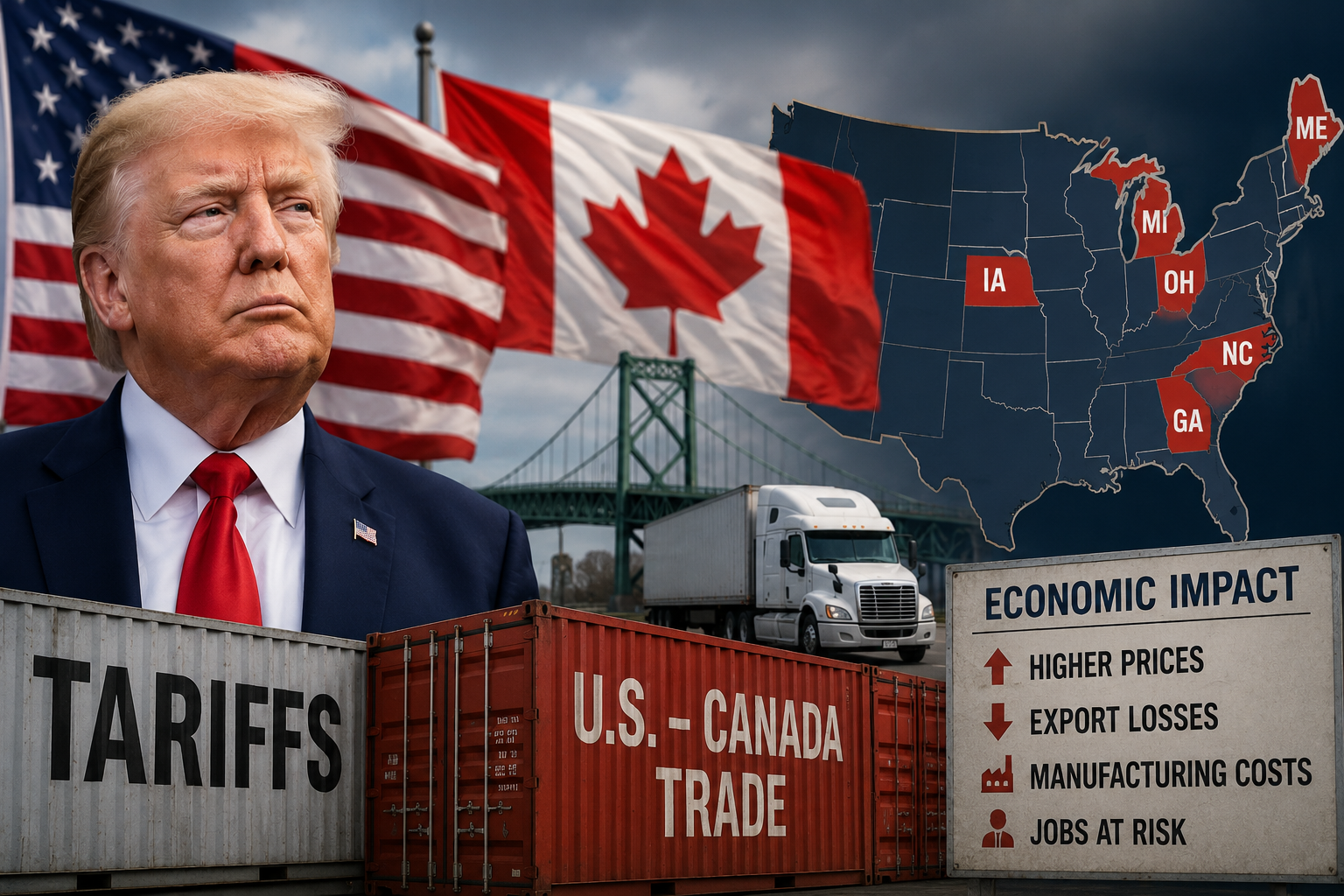
President Donald Trump’s escalating trade fight with Canada is creating a problem that is both economic and political.
The White House argues that higher tariffs are needed to counter what it describes as unfair Canadian treatment of U.S. exports. The administration says the measures are intended to protect American workers, farmers and businesses.
But the immediate political risk is becoming harder to ignore.
A new Reuters/Ipsos poll found that only 20% of Americans support higher tariffs on Canadian goods, while 57% oppose them.
That would matter in any election year.
It matters even more in 2026 because some of the states most exposed to U.S.-Canada trade are also among the states that could decide control of the Senate.
The real question is no longer simply whether Trump can justify the tariffs as “fair” trade policy.
It is whether voters in trade-sensitive states begin to experience them as a cost-of-living problem.
Why Canada matters more than the rhetoric suggests
Canada is not a marginal trading partner.
The Office of the U.S. Trade Representative says Canada has consistently been one of America’s top two trading partners. In 2025, total U.S.-Canada goods and services trade was estimated at $872.3 billion. U.S. goods exports to Canada totaled $333.6 billion, while imports totaled $381.9 billion.
The two economies are deeply integrated.
Automotive production, energy, agriculture, machinery and other industries rely on supply chains that cross the border repeatedly.
That matters because tariffs do not fall neatly on a foreign country.
They can also affect U.S. importers, manufacturers and consumers who rely on Canadian inputs.
Trump and his advisers argue that tariffs can force trading partners to make concessions and reduce what they view as discriminatory trade practices.
The economic risk is that the same tariffs can raise input costs and invite retaliation.
Canada is retaliating
Canada has announced retaliatory tariffs on hundreds of U.S. products, with measures scheduled to take effect September 8. The products include steel, fish, cheese, smartphones, household goods and other exports.
That changes the political equation.
When the United States taxes imports, the pain can show up through higher costs for American firms or consumers.
When Canada retaliates, U.S. exporters can also lose sales or face reduced competitiveness in one of their biggest markets.
The result is a two-sided squeeze.
American businesses that buy Canadian materials can face higher costs.
American businesses that sell into Canada can face higher barriers.
And politicians in states that depend heavily on cross-border trade can be left explaining why a national trade dispute is hurting local employers.
The Senate map makes this more dangerous
This is where the tariff fight becomes a midterm story.
AP reported that Maine, Michigan, Ohio and Alaska are among the states where the Canada dispute could become especially politically sensitive because trade with Canada is economically important and Senate races are competitive.
PolitiFact noted that six of the eight most competitive Senate races are in states where Canada is the top trading partner: Georgia, Iowa, Maine, Michigan, North Carolina and Ohio.
That creates an unusual alignment between trade exposure and electoral importance.
In Maine, industries such as lobster, blueberries and lumber depend heavily on Canadian customers.
In Michigan, roughly one-third of exports go to Canada, according to AP’s reporting on the dispute.
In industrial states such as Ohio, manufacturers can be exposed through steel, machinery and cross-border supply chains.
The political risk for Republicans is straightforward:
If the tariffs produce visible price increases, lost export orders or business uncertainty in those states, Democrats have a ready-made argument that Trump’s trade policy is making everyday economic problems worse.
Why this could become a cost-of-living issue
Tariffs are often discussed as an industrial or trade-policy tool.
Voters may experience them differently.
Earlier Ipsos polling found that 74% of Americans believed tariffs would raise prices on goods they buy, and 73% said tariffs on imported goods would lead to higher prices on food, electronics and other products.
That perception is politically important because cost of living is already one of the biggest vulnerabilities facing Republicans in the midterms.
If voters already believe tariffs raise prices, then a new round aimed at Canada risks reinforcing an existing affordability problem.
The effect would not necessarily be immediate or uniform.
Some companies may absorb costs.
Some may switch suppliers.
Some products may not rise much at all.
But in tightly integrated sectors — especially autos, metals, energy and agriculture — companies have fewer easy alternatives.
That is where tariff costs are more likely to spill into prices, margins or investment decisions.
The auto industry is especially exposed
North American auto production is one of the clearest examples of cross-border integration.
Cars and trucks are assembled from parts that can move between the United States and Canada multiple times before a finished vehicle reaches a dealership.
That means tariffs can compound through the supply chain.
The administration has already threatened to raise tariffs on Canadian cars, trucks and auto parts to 50% beginning in 2027 if the dispute is not resolved.
For automakers, that creates uncertainty even before any future increase takes effect.
Investment decisions depend on predictable costs.
If companies cannot be sure what tariff rates will apply next year, they may delay expansion, shift sourcing or demand concessions from suppliers.
Those decisions can eventually affect jobs and consumer prices.
Trump’s argument — and where it could succeed
The administration’s case is that Canada has engaged in trade practices that disadvantage U.S. producers.
USTR has specifically cited Canadian policies affecting alcohol, dairy and vehicle exports, while arguing that tariffs are intended to restore reciprocity and protect strategic U.S. industries.
That argument can appeal to voters who believe previous trade agreements hollowed out U.S. manufacturing or gave foreign producers unfair advantages.
And if the pressure produces concessions from Canada without causing major economic disruption, the White House could claim the strategy worked.
That is a plausible scenario.
But it depends on outcomes, not rhetoric.
The political benefit only materializes if voters see stronger U.S. industry, better trade terms or new investment.
If they instead see higher prices, disrupted supply chains or retaliatory tariffs hitting local employers, the same policy becomes a liability.
Public opinion is already running against the tariffs
The latest Reuters/Ipsos numbers suggest Trump begins this fight from a weak position.
Only one in five Americans support the new tariffs, while a clear majority oppose them.
That does not mean trade policy will decide the midterms by itself.
Most voters will never study Section 338 of the Tariff Act or follow every negotiation between Washington and Ottawa.
But they do notice grocery bills, car prices, fuel costs and local layoffs.
That is how an obscure trade dispute can become an electoral issue.
Three scenarios to watch
Scenario 1: Trump gets concessions and de-escalates
Trigger: Canada agrees to changes on market access or trade rules.
Political consequence: Republicans can argue that pressure worked.
Economic consequence: Tariff-related uncertainty falls and businesses regain planning visibility.
What would support it: renewed negotiations, suspended retaliation or announced bilateral concessions.
Scenario 2: The tariffs stay, but the economic impact remains limited
Trigger: companies absorb costs or adjust supply chains faster than expected.
Political consequence: the issue fades behind inflation, immigration or foreign policy.
Economic consequence: sector-specific pain without a broad consumer shock.
What would support it: stable consumer prices and limited business disruption in trade-heavy states.
Scenario 3: Retaliation hits battleground states
Trigger: Canadian tariffs reduce demand for U.S. exports while import costs rise.
Political consequence: Democrats target vulnerable Republicans in Maine, Michigan, Ohio and other trade-sensitive states.
Economic consequence: exporters lose sales, manufacturers face higher costs and some prices rise.
What would support it: company warnings, layoffs, weaker export data or visible price increases in affected industries.
What happens next
The most important date is September 8, when Canada’s new retaliatory tariffs are scheduled to take effect.
From there, watch three things:
- whether Washington and Ottawa reopen negotiations;
- whether U.S. businesses begin publicly warning about costs;
- whether Republican candidates in battleground states distance themselves from the policy.
Those reactions may tell us more about the political consequences than the tariff rate itself.
For now, Trump’s Canada strategy presents Republicans with a difficult trade-off.
They can defend a policy aimed at forcing better trade terms.
But if the fight raises prices or damages local industries in the states that decide the Senate, voters may judge it less as trade strategy and more as another hit to their wallets.
That is the risk.
And with the midterms approaching, the states most exposed to the trade fight may also be the states Republicans can least afford to lose.