Donald Trump is turning the 2026 midterms into something presidents usually try to avoid: a referendum on himself.
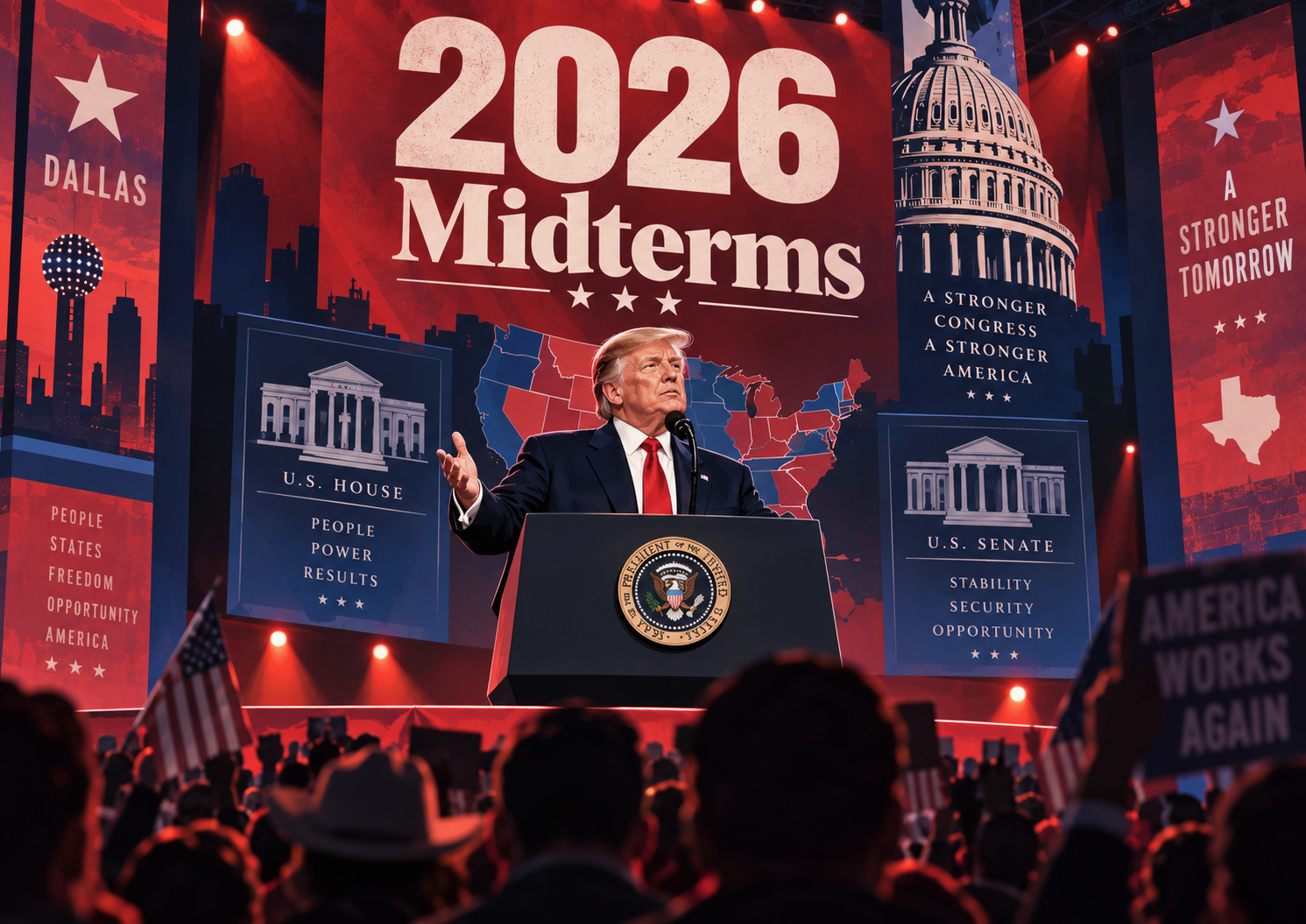
The Republican Party is holding an unusual national midterm convention in Dallas this week, with Trump expected to dominate the event, speak on both days and help frame the closing argument for GOP candidates heading into November. Reuters reports the gathering is expected to draw roughly 30,000 attendees and has a budget of about $40 million.
The strategy is obvious. Trump wants to energize Republican voters, remind them of his administration’s accomplishments and make the election feel consequential enough to overcome the traditional midterm problem facing the president’s party.
The risk is just as obvious.
Trump’s approval rating is around 33% in recent Reuters/Ipsos polling, and Republicans are already facing voter frustration over inflation, the Iran war and affordability. By placing himself at the center of the campaign, Trump may help motivate MAGA voters — but he may also give Democrats exactly the national referendum they want.
Why the Dallas convention is unusual
National political conventions are normally associated with presidential election years.
Midterm campaigns are usually more decentralized. House candidates talk about their districts. Senate candidates emphasize state issues. Vulnerable incumbents often try to localize their races rather than attach themselves too closely to an unpopular national figure.
The Dallas event breaks with that model.
Reuters reports that Trump is scheduled to appear both days at the American Airlines Center, alongside Vice President JD Vance and Cabinet figures including Treasury Secretary Scott Bessent and Health Secretary Robert F. Kennedy Jr. The convention is designed to highlight themes including trade, public safety, manufacturing, healthcare and attacks on what Republicans describe as Democratic extremism.
It is, in effect, a presidential-style convention for an election in which Trump is not actually on the ballot.
That makes the event an experiment.
Trump’s theory: turnout can beat the midterm curse
Presidents often struggle in midterm elections because the opposing party is more motivated.
Trump’s answer appears to be simple: make Republican voters feel as if he is on the ballot anyway.
He has already promised to campaign aggressively for GOP candidates in roughly three dozen competitive races and has said he will make numerous stops around the country before Election Day.
That could work.
Trump has repeatedly shown an ability to generate intense loyalty among Republican voters. A nationalized campaign built around him could raise turnout among voters who might otherwise be less interested in a congressional election.
For candidates in heavily Republican states and districts, that may be an advantage.
But the electoral map is not composed only of safe Republican territory.
The House majority could turn on a relatively small number of competitive suburban and swing districts. Senate control may depend on races in places such as Michigan, Texas, Georgia, North Carolina, Maine and Ohio.
In those races, attaching the campaign too closely to Trump creates a different calculation.
The 33% problem
The central tension in the strategy is Trump’s own political standing.
Reuters reports his approval rating is around 33%, near the lowest point of his political career. Inflation remains a concern, and the ongoing war with Iran is deeply unpopular. Only about a quarter of Americans recently told Reuters/Ipsos that the Iran war was worthwhile.
That means Trump is trying to become the face of an election while a substantial majority of voters disapprove of his performance.
For Democrats, that creates a straightforward message.
They do not necessarily need every House or Senate race to be about the individual Republican candidate.
They can try to make it about Trump.
If voters dislike the president’s handling of the economy, foreign policy or cost of living, Democrats want those frustrations transferred onto Republican candidates who support him.
A Dallas convention designed around Trump makes that argument easier to draw visually and politically.
Why some Republicans may prefer distance
There is a reason vulnerable lawmakers often spend the final weeks of a campaign in their districts rather than on national stages.
Local candidates want to talk about local issues.
House Speaker Mike Johnson acknowledged that many lawmakers would remain in their districts rather than attend the Dallas gathering, according to Reuters.
That does not necessarily mean they are rejecting Trump.
It may simply mean their electoral incentives are different.
A Republican running in a safe district may benefit from appearing beside Trump.
A Republican in a district that voted narrowly for either party in 2024 may prefer to talk about roads, taxes, crime or local industry.
The closer the race, the more dangerous it can be to surrender control of the campaign narrative to a national figure.
Texas shows the contradiction
Holding the convention in Texas is symbolically powerful for Republicans.
But it also highlights one of the party’s unexpected vulnerabilities.
The state’s Senate race between Republican Ken Paxton and Democrat James Talarico has become competitive enough that national Republicans are spending heavily to defend what would ordinarily be considered a safe seat.
That is exactly the kind of race where Trump’s involvement can cut both ways.
He may help mobilize conservative voters who strongly support him.
But a hyper-nationalized campaign could also energize Democrats and independents who dislike the president.
Texas therefore becomes a useful test of the broader strategy: can Trump’s turnout power outweigh his unpopularity among persuadable voters?
Republicans are also trying to make the election about the left
Trump is not the only component of the GOP strategy.
Republicans are simultaneously trying to define Democrats through their progressive wing.
Reuters has described the party’s approach as two-pronged: defend Trump’s record while portraying Democrats as increasingly dominated by socialism, progressive activism and controversial cultural positions.
That helps explain why figures such as Abdul El-Sayed have become national Republican targets.
If Republicans cannot persuade voters to view the midterms purely as a referendum on Trump’s performance, they have another argument ready:
The alternative is worse.
That strategy gives the Dallas convention two jobs.
It must energize voters around Trump while also making voters afraid of Democratic control.
Three ways the gamble could play out
Scenario 1: Trump energizes Republican turnout
The convention works.
Trump creates excitement, MAGA voters show up in unusually high numbers and Republican candidates benefit from a turnout surge.
Evidence for this scenario would include stronger Republican early-vote numbers, higher enthusiasm among GOP voters and improved polling in competitive House districts.
In that case, Trump may have found a way to reduce the usual midterm penalty facing the president’s party.
Scenario 2: Democrats successfully nationalize the election
Trump dominates the campaign so completely that Democratic candidates barely need to define their Republican opponents.
They simply run against him.
His approval rating, the Iran war, prices and economic frustration become the backdrop to dozens of congressional races.
If Democratic enthusiasm rises while swing voters move away from Trump-aligned Republicans, the convention could end up accelerating the very backlash it was designed to prevent.
Scenario 3: Trump helps in red territory and hurts in the middle
This may be the most plausible mixed outcome.
Trump could boost Republican turnout in conservative areas while simultaneously creating problems for candidates in suburban and swing districts.
That would produce an uneven map: strong Republican performance in safe territory but losses in precisely the competitive seats that determine House and Senate control.
What to watch after Dallas
The most important evidence will come after the convention, not during it.
Watch:
- Trump’s approval rating;
- Republican versus Democratic enthusiasm;
- polling in swing House districts;
- Texas, Michigan, Georgia and North Carolina Senate races;
- whether vulnerable Republicans increasingly campaign with Trump or create distance;
- and whether Democratic advertising shifts even more aggressively toward making the election a referendum on the president.
The convention itself will generate spectacle.
The strategic question is whether that spectacle translates into votes.
Trump is betting that he is still the GOP’s greatest asset
There is a deeper reason this convention matters.
Trump’s political model has always depended on the belief that his personal connection with Republican voters is stronger than normal party politics.
Dallas puts that theory to a direct electoral test.
If Republicans outperform expectations in November, Trump will likely argue that his personal campaigning saved the party from the normal midterm backlash.
If Republicans lose the House — or worse, both chambers — Democrats will argue that he turned a congressional election into a referendum on a president voters were already unhappy with.
Either outcome would shape the rest of Trump’s presidency.
That is what makes the Dallas convention more than a rally.
It is a bet that the Republican Party still benefits more from more Trump, not less.