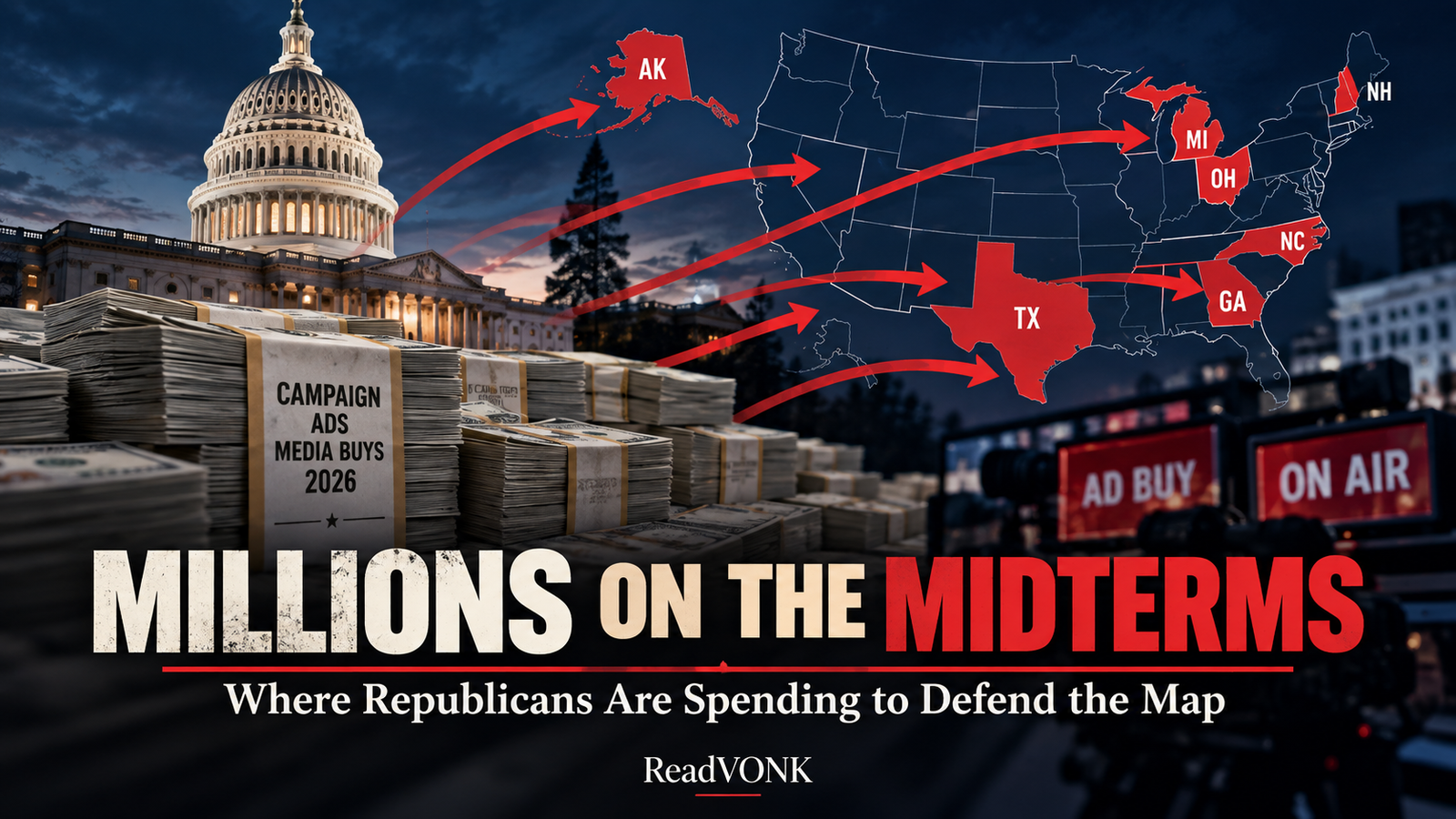
Republicans are beginning to spend like a party that knows the 2026 map is getting uncomfortable.
With less than eight weeks until Election Day, political groups tied to Donald Trump and Elon Musk are pouring tens of millions of dollars into Senate battlegrounds across the country.
Trump-affiliated group No Going Back has booked roughly $24.9 million in advertising across Alaska, Georgia, Michigan, North Carolina, New Hampshire and Ohio, according to Reuters. Trump has also said he intends to direct between $400 million and $500 million toward Republican candidates.
Meanwhile, Trump’s MAGA Inc. and Musk’s America PAC are spending heavily in Texas, where Republican Ken Paxton is facing Democrat James Talarico.
That matters because political spending is not just advertising.
It is information.
Money tells you where campaigns see danger
Parties do not spend millions defending races they consider completely safe.
Texas is the clearest example.
Republicans have dominated statewide elections there for decades. But after Paxton won the Republican nomination, Democrats began treating Talarico as a legitimate opportunity.
MAGA Inc. responded with a $10 million advertising campaign. AP described it as Trump’s first major general-election investment of the midterm cycle.
The message is hard to miss: Republicans would prefer to spend that money attacking Democrats in states like Michigan or Georgia.
Instead, some of it is being used to protect Texas.
The map is expanding
The same dynamic is visible elsewhere.
Republicans are defending Senate seats in Ohio, Alaska and North Carolina while trying to pick up Democratic seats in Michigan, Georgia and New Hampshire.
For Democrats, this creates a resource strategy.
They do not necessarily need every long-shot state to flip.
If a competitive Democrat forces Republicans to spend $10 million, $20 million or more defending a state they expected to hold, that money cannot be used somewhere else.
That is why candidates like Talarico, Sherrod Brown and Mary Peltola matter even beyond their own states.
They stretch the map.
Trump is now personally tied to the outcome
Trump’s involvement also creates a political risk.
He spent the Republican convention in Dallas urging voters to treat the midterms as if he were personally on the ballot.
But his approval rating has fallen sharply, and polling cited by Reuters shows Democrats currently more motivated to vote.
That means Republican spending has two jobs.
It must help individual candidates.
And it must overcome dissatisfaction with the president leading their party.
What happens next
Watch where the next $50 million goes.
If Republican money continues flowing into Texas, Ohio and Alaska, that would be a sign the party still believes traditionally Republican territory requires protection.
If the spending shifts toward Michigan, Georgia and New Hampshire, it would suggest Republicans feel more secure about their own seats and are moving onto offense.
Either way, the money is giving voters an unusually clear view of the battlefield.
And right now, Republicans are defending more territory than they expected.
Sources: · Reuters — Trump and Musk super PACs increase spending in battleground races: https://www.reuters.com/legal/government/trump-musk-super-pacs-unleash-millions-boost-republicans-battleground-races-2026-09-11/
AP — broader 2026 Senate battlefield and Republican vulnerabilities: https://www.washingtonpost.com/politics/2026/09/08/senate-democrats-republicans-midterm-elections/f2df0302-ab39-11f1-b498-8697f35a6743_story.html?