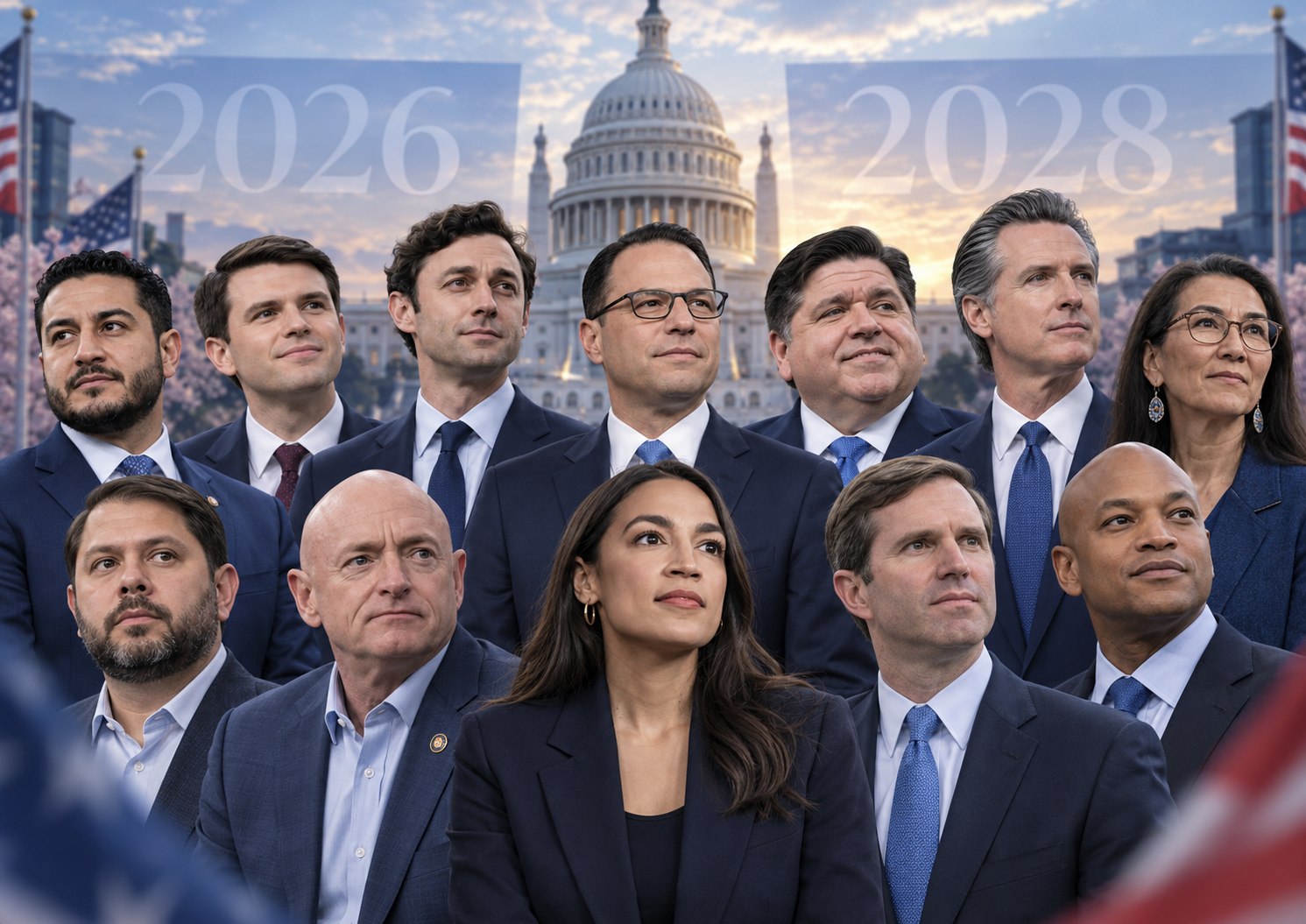
Democrats are trying to win back Congress in 2026. But another contest is already taking shape behind the midterms: who will define the party after Donald Trump leaves office?
Some of the names are obvious. Gavin Newsom has spent years building a national profile. Alexandria Ocasio-Cortez is one of the most recognizable progressives in the country. Governors Josh Shapiro, Wes Moore, Andy Beshear and JB Pritzker are increasingly discussed as potential 2028 contenders.
But the more interesting part of the Democratic bench may be emerging further down the ballot.
Abdul El-Sayed is trying to win a crucial Michigan Senate race after defeating the party establishment in a bruising primary. James Talarico has helped turn Texas into an unexpectedly important Senate contest. Jon Ossoff is defending one of the most valuable seats Democrats hold. Mary Peltola is trying to prove that a Democrat can still build an unusual coalition in Alaska.
The 2026 election therefore isn’t just about who controls Congress.
It could determine which Democrats enter 2027 with a national future — and which political models voters decide are worth copying.
1. Abdul El-Sayed: the progressive test in Michigan
Few 2026 candidates could change perceptions of the Democratic Party as dramatically as Abdul El-Sayed.
The physician and progressive won Michigan’s Democratic Senate primary after defeating Rep. Haley Stevens, a more moderate candidate, in a bitter and expensive contest. He now faces Republican Mike Rogers in a race Reuters identifies as one of the key contests that could determine Senate control.
El-Sayed’s significance goes beyond one seat.
He has campaigned on healthcare, economic inequality and ending unconditional U.S. military aid to Israel. Republicans are trying to portray him as too far left for a swing state. Democrats, meanwhile, will find out whether a progressive candidate capable of energizing younger and left-leaning voters can also assemble a statewide general-election coalition.
If El-Sayed wins, he would become the first Muslim elected to the U.S. Senate. More importantly for party strategy, Democrats would have evidence that a clearly progressive platform can work in a genuine battleground.
2. James Talarico: the Texas breakout candidate
A year ago, relatively few Americans outside Texas knew James Talarico.
That could change quickly.
The Democratic state representative is challenging Republican Ken Paxton in a Texas Senate race that has become competitive enough to attract major national Republican spending. Trump’s MAGA Inc. super PAC committed at least $10 million to helping Paxton, including money for both pro-Paxton and anti-Talarico advertising.
That makes Talarico one of the most interesting asymmetric opportunities in Democratic politics.
He does not necessarily have to win to emerge with a national future. If he forces Republicans to spend heavily in Texas, substantially narrows the state’s traditional Republican advantage or actually wins statewide, Democratic donors and strategists will immediately ask whether his political style can travel elsewhere.
Texas has not elected a Democrat statewide in decades. That is precisely why a serious challenge there gets attention.
3. Jon Ossoff: survive Georgia, enter the next tier
Jon Ossoff already has a national profile. But 2026 may decide whether he gets something more valuable: long-term credibility in presidential politics.
The Georgia senator is defending his seat against Republican Mike Collins in one of the races that will help determine Senate control. Reuters’ current battlefield assessment has Ossoff ahead, but Georgia remains one of the country’s most competitive states.
Winning another statewide race in Georgia would strengthen Ossoff’s argument that he can compete in territory national Democrats cannot afford to lose.
A defeat could dramatically reduce the 2028 speculation around him.
In other words, Georgia isn’t just a Senate defense. It is potentially an audition.
4. Alexandria Ocasio-Cortez: the progressive movement’s biggest brand
Unlike many people on this list, Alexandria Ocasio-Cortez does not need 2026 to become famous.
Her question is what she does with that fame.
AOC has left open the possibility of either a 2028 presidential campaign or a future Senate challenge, while positioning herself as a potential heir to the political movement built around Bernie Sanders.
Her influence also creates a larger strategic question for Democrats.
Can the party’s progressive wing move from influencing the agenda to controlling the presidential nomination?
If progressive candidates such as El-Sayed perform strongly in 2026, AOC’s model gains credibility. If Democrats conclude that moderate candidates dramatically outperformed, the argument moves the other way.
5. Josh Shapiro: the swing-state model
Pennsylvania Gov. Josh Shapiro offers Democrats almost the opposite theory.
Rather than building his brand primarily around ideological confrontation, Shapiro has emphasized competence, governing and broad electoral appeal in one of the country’s most important swing states.
His 2026 reelection has implications far beyond the governor’s mansion. Pennsylvania also contains several competitive House seats, meaning a strong Shapiro performance could help demonstrate whether his coalition can lift Democrats down-ballot.
Shapiro has described the coming fight over the Democratic Party’s direction in unusually consequential terms, while remaining less eager than some rivals to openly campaign as a presidential candidate.
If he wins comfortably in a state Trump carried in 2024, that will be noticed.
6. Wes Moore: a national profile without a presidential campaign — yet
Maryland Gov. Wes Moore is increasingly appearing where ambitious national politicians tend to appear: on campaign trails outside their own states.
Moore has been campaigning for Democrats around the country while speculation about 2028 continues.
His potential appeal is relatively easy to understand.
He is a governor rather than a Washington legislator, has executive experience, can speak to both establishment and newer Democratic constituencies, and would bring generational change to the ticket.
The challenge is differentiation. The prospective 2028 field could contain several successful Democratic governors making similar arguments.
7. Andy Beshear: can the Kentucky formula go national?
Andy Beshear may have the most unusual résumé of the Democratic governors considering what comes next.
He governs Kentucky, a state that otherwise votes heavily Republican at the federal level.
That gives him a ready-made political argument: he knows how to persuade voters who do not ordinarily support Democrats.
Beshear is currently chairing the Democratic Governors Association and campaigning beyond Kentucky, while facing pressure from Democratic leaders to invest aggressively in states such as Texas. Axios reports that his decisions are being watched partly through the lens of a possible 2028 run.
If Democrats believe their central problem is rebuilding support among working-class and red-state voters, Beshear could become particularly interesting.
8. JB Pritzker: money, organization and confrontation
Illinois Gov. JB Pritzker brings a different set of assets.
He has substantial personal wealth, access to donors, executive experience and a willingness to confront Republicans nationally.
Axios includes Pritzker among the Democratic governors actively weighing the political terrain ahead of 2028.
The obvious weakness is geography: winning Illinois tells Democrats less about general-election performance in a battleground than winning Pennsylvania, Georgia or Arizona.
But presidential campaigns require more than swing-state credentials. They require money, organization, message discipline and the ability to survive a long primary.
Pritzker has several of those ingredients already.
9. Gavin Newsom: the candidate everyone already assumes is running
California Gov. Gavin Newsom is perhaps the least surprising name here.
His behavior increasingly resembles that of someone preparing for a national contest, and his positioning toward the Biden legacy is already being analyzed through the lens of a prospective 2028 Democratic primary.
Newsom’s advantage is obvious: enormous name recognition and years of national media exposure.
His problem is equally obvious.
Everyone already knows him.
That means Newsom enters any future race with fewer opportunities to reinvent himself than a Shapiro, Moore or Beshear. By 2028, Democrats may either see him as the battle-tested figure best prepared to fight Republicans — or as yesterday’s answer to a party looking for something new.
10. Ruben Gallego: a different path through Arizona
Arizona Sen. Ruben Gallego deserves more attention in the 2028 conversation than he sometimes receives.
Axios reported this summer that both Gallego and fellow Arizona Sen. Mark Kelly were openly fueling speculation about possible presidential campaigns.
Gallego brings several potentially valuable pieces of a Democratic coalition together: Latino background, military service, a working-class political story and experience winning statewide in a battleground.
Arizona also gives him something California and Illinois politicians cannot claim: repeated exposure to highly competitive general elections.
His challenge is national recognition. That could change quickly if he begins campaigning aggressively outside Arizona.
11. Mark Kelly: the general-election résumé
Gallego’s fellow Arizona senator, Mark Kelly, offers another version of the swing-state candidate.
Kelly is a Navy veteran and former astronaut who has repeatedly won statewide elections in Arizona. Like Gallego, he has acknowledged the possibility of a 2028 campaign.
His political proposition would likely be less about transforming the Democratic Party than reassuring voters that he could win a national general election.
That could become attractive if Democrats emerge from 2026 convinced that electability is their overriding priority.
But crowded primaries don’t always reward the candidate with the most conventional general-election résumé.
12. Mary Peltola: watch what happens in Alaska
Mary Peltola is the least obvious presidential name on this list — and that’s precisely why she belongs here.
The former House member is now challenging Republican Sen. Dan Sullivan in Alaska, another race Reuters identifies as potentially important to Senate control.
Peltola has previously demonstrated an ability to win in political terrain where Democrats normally struggle.
If she wins a Senate seat in Alaska, national Democrats will study how she did it: candidate brand, local identity, coalition-building and distance from national partisan stereotypes.
Not every rising political figure needs to become president.
Some matter because they teach their party how to win somewhere it usually loses.
2026 could answer the Democrats’ biggest question
The most important Democratic story after Trump may not be which individual politician becomes the 2028 nominee.
It may be which political model survives 2026.
If Abdul El-Sayed wins Michigan, progressives will argue that bold ideological politics can succeed in swing states.
If James Talarico comes close or wins in Texas, Democrats will search for ways to reproduce his appeal.
If Shapiro wins decisively in Pennsylvania and helps House candidates with him, moderates will point to that as evidence for a broader coalition.
If Ossoff survives Georgia, Gallego and Kelly continue winning in Arizona, or Peltola takes Alaska, Democrats will have additional evidence that candidate-specific brands still matter enormously.
Meanwhile, Newsom, Moore, Beshear, Pritzker and AOC will be watching the same results.
Because the 2028 Democratic primary will not begin with a blank sheet of paper.
The arguments that define it are being tested in 2026.