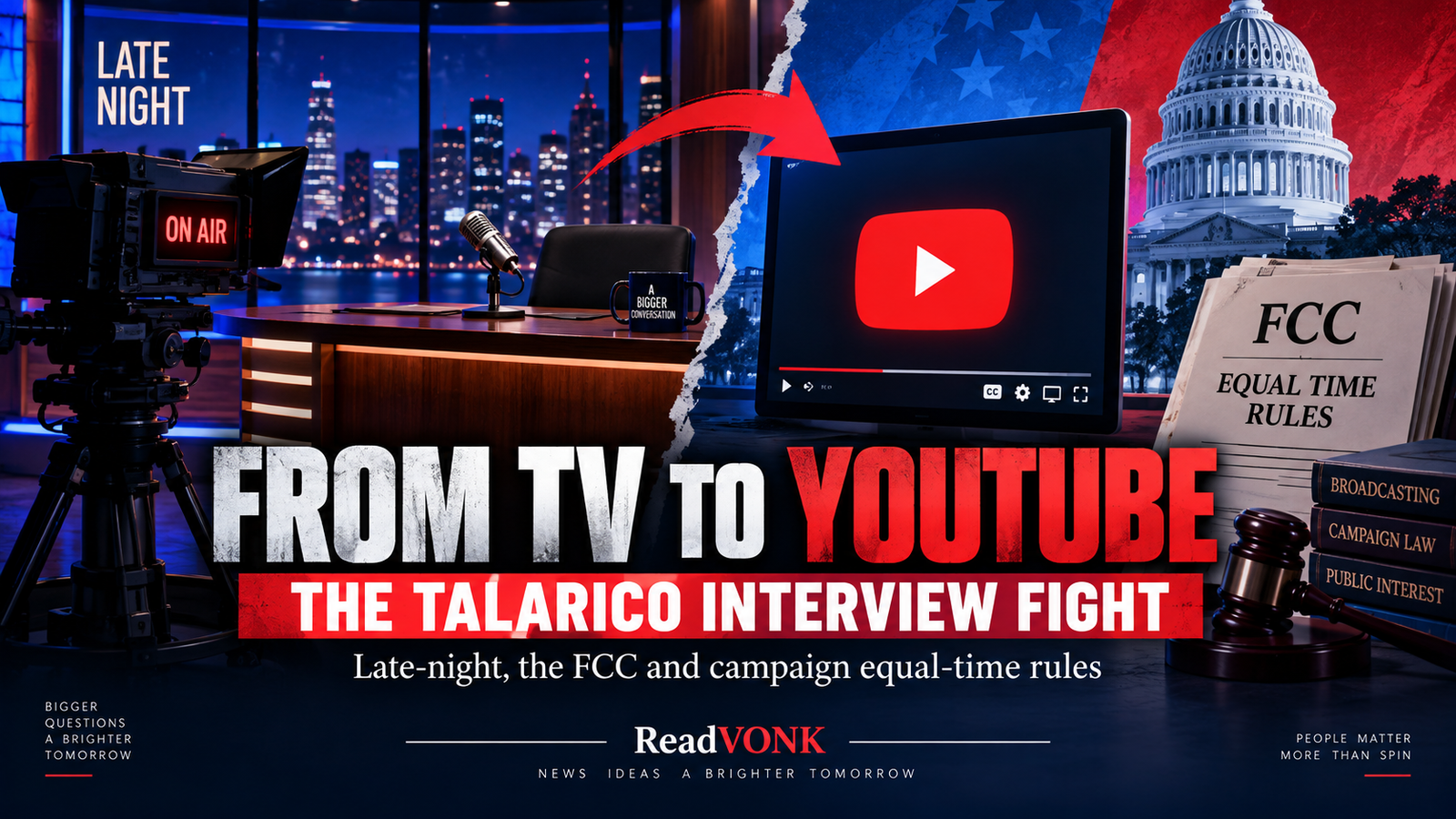
James Talarico was supposed to appear on Jimmy Kimmel’s television show.
Instead, the Texas Democratic Senate candidate’s interview is heading to YouTube.
That seemingly small programming decision has turned into a much larger argument about elections, government regulation and political speech.
Kimmel says ABC kept the interview off broadcast television because of pressure from the Federal Communications Commission over rules governing appearances by political candidates.
The FCC disputes the characterization that candidates are being censored.
And Talarico has once again found himself at the center of a national political controversy.
What happened
Kimmel announced that his interview with Talarico would be made available on YouTube rather than broadcast on ABC.
According to AP and Reuters, network concerns centered on the FCC’s treatment of the “equal opportunities” requirement for candidates.
It is not the first time this has happened to Talarico.
A planned appearance on Stephen Colbert’s program earlier this year was also moved online amid concerns that broadcasting it could create obligations involving rival candidates.
What is the equal-opportunities rule?
People often call it the “equal time” rule.
The legal concept is more accurately called equal opportunities.
Broadcasters that allow a legally qualified candidate to use their station can, in some circumstances, become obligated to provide comparable opportunity to opposing candidates.
There are exemptions, including certain bona fide news programming.
The dispute is about how those rules apply to entertainment and late-night programs that regularly discuss politics.
The FCC maintains that broadcasters are not prohibited from interviewing candidates and can satisfy the rules by giving comparable access to rivals. In an earlier FCC letter involving late-night programming, Chairman Brendan Carr argued that these obligations are longstanding rather than new censorship.
Kimmel sees government intimidation
Kimmel’s interpretation is very different.
He argues that the FCC’s current approach is pressuring networks to avoid political interviews they previously would have broadcast.
Democratic FCC Commissioner Anna Gomez has also criticized the agency’s approach, arguing that government pressure is affecting editorial decisions.
That turns the story from a campaign booking dispute into a First Amendment argument.
How much power should a federal regulator have over the editorial decisions of television stations?
The FCC has a counterargument
There is another side that matters.
The equal-opportunities requirement was not invented for Talarico.
The FCC has regulated candidate access to broadcast stations for decades.
Its stated purpose is to prevent broadcasters from giving one legally qualified candidate preferential access over another.
From that perspective, the issue is not:
“Can James Talarico go on television?”
It is:
“If he does, what obligations does the broadcaster have toward Ken Paxton?”
That distinction is important.
Why YouTube changes everything
Traditional broadcast television operates under federal licenses and FCC rules.
YouTube does not operate under the same broadcast framework.
Moving the interview online therefore gives Kimmel and Talarico a way around the immediate regulatory dispute.
But it also illustrates a larger transformation in political media.
Campaigns increasingly do not need television.
Podcasts.
YouTube.
Threads.
TikTok-style video.
Streaming.
Candidates can reach millions without asking a traditional broadcaster for airtime.
The more regulatory friction television faces, the stronger that incentive becomes.
This could actually help Talarico
There is an irony in the controversy.
Had the interview simply aired as planned, it might have been one late-night appearance among hundreds.
Moving it off television has generated national news coverage.
That gives Talarico a much larger political narrative:
He is no longer merely a Democratic Senate candidate appearing on a comedy show.
He can present himself as part of a broader debate over government pressure, media independence and free speech.
Republicans can counter that broadcasters should follow rules designed to ensure fairness between candidates.
Either way, Talarico receives more national attention.
What happens next
The question is whether other television programs begin making the same decision.
If networks routinely move candidate interviews online, the practical effect of FCC policy could extend far beyond this Texas race.
Political campaigning could migrate even faster away from traditional broadcast television.
That would be an unintended consequence worth watching.
A fight that began with one candidate and one late-night interview may become a much bigger argument about how political speech reaches voters in the digital age.
Sources
Associated Press — Kimmel says Talarico interview won’t air on TV amid FCC disputehttps://apnews.com/article/d3b6ccd636d8b94bd9485e7082438046
Reuters — ABC’s Kimmel says Talarico interview will not air on networkhttps://www.reuters.com/world/us/abcs-jimmy-kimmel-says-senate-candidate-interview-will-not-air-network-2026-09-10/
FCC — Chairman Carr letter explaining equal-opportunities obligationshttps://docs.fcc.gov/public/attachments/DOC-420011A2.pdf