Washington has always attracted money. What is different in the 2026 midterms is who is spending it — and how much they appear to believe is on the line.
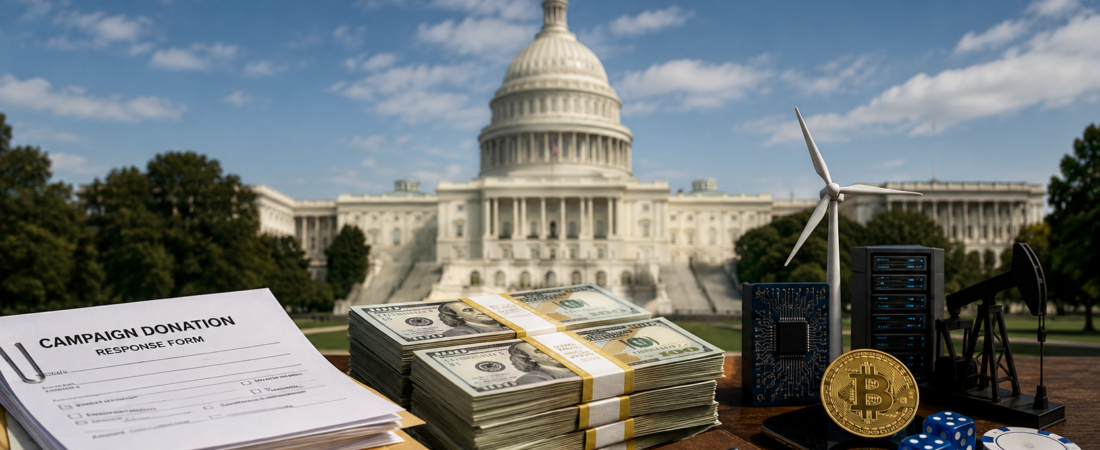
Corporate political donations in federal races have already hit a record $646 million in the 18 months through June, according to a new analysis from Public Citizen based on Federal Election Commission filings. That is 40% more than corporations spent during the entire 2024 presidential cycle.
The raw number is striking. But the more important story is what it says about the next phase of American politics.
This is not just a story about traditional business interests trying to maintain access in Washington. It is increasingly a story about newer industries — especially crypto, online betting, and artificial intelligence — trying to shape the rules of the game before Congress, regulators, and the White House shape them instead.
The new political money map
For years, the familiar corporate names in campaign finance came from sectors like energy, manufacturing, tobacco, finance, and healthcare. Those players are still here.
But 2026 shows a new layer of political money rising fast.
According to the Public Citizen analysis, crypto, online betting, and AI interests together account for hundreds of millions of dollars in spending, making them some of the biggest forces in the midterms. Sports-betting companies alone have poured tens of millions into the cycle.
That matters because these are not industries donating out of habit. They are donating because they are fighting live policy battles.
Crypto companies want friendlier market-structure rules, more regulatory clarity, and a less hostile enforcement environment. AI companies have major interests in copyright, liability, energy access, antitrust, and export controls. Online betting companies are watching tax policy, advertising restrictions, state expansion fights, and federal scrutiny of the sector.
In other words, this money is not random. It is targeted.
Why 2026 matters so much
Midterms are often framed as a referendum on the sitting president or the balance of power in Congress. That is true, but for corporate donors the stakes are more specific.
They are spending now because the winners of the 2026 elections could shape:
- who controls key congressional committees;
- which bills get hearings and votes;
- how aggressively agencies regulate emerging industries;
- whether tax and spending deals include industry-specific benefits or burdens;
- and how much political protection companies have in the next two years.
That is why political money often floods toward uncertainty. And 2026 has plenty of it.
Republicans are trying to defend control of Congress in a difficult environment. Democrats are looking for openings. New industries that feel economically important but politically vulnerable are trying to build influence with whoever may hold power after November.
Some of that money is going disproportionately to Republicans. Some is going to candidates in both parties. In either case, the broader point is the same: corporate America is not waiting to see who wins. It is trying to shape the outcome and the policy agenda that follows.
The industries to watch
Crypto
Crypto has already shown how quickly it can become a serious political force. The sector learned in recent election cycles that campaign spending can buy more than attention — it can buy access, allies, and a more favorable legislative climate.
That strategy now appears to be expanding. The sector’s political goal is not just survival. It is to turn itself from a controversial asset class into a normalized part of the financial system, with rules written on terms it can live with.
Online betting
Online sports betting may be one of the most underappreciated political stories of the cycle.
The industry is still relatively new as a major political spender, but it has strong incentives to influence policymakers. Expansion fights are ongoing in many states, tax rates can dramatically affect profitability, and lawmakers can still tighten advertising, consumer-protection, or licensing rules.
A company that sees regulation as an existential risk has every incentive to treat campaign spending as a cost of doing business.
Artificial intelligence
AI money may be the most consequential over the long term.
AI companies are not just lobbying over one narrow issue. They are potentially lobbying over labor, intellectual property, chip controls, electricity demand, data access, safety rules, antitrust, and procurement. That gives them a reason to build political influence across multiple committees and agencies at once.
This is part of what makes the 2026 cycle different. Washington is not just seeing more money. It is seeing money from industries that expect to shape the next decade of the U.S. economy.
What this means for the election
The simplest takeaway is that money still matters — especially in competitive House and Senate races where outside groups can define candidates before voters know much about them.
That does not mean money automatically decides elections. Candidates still matter. Issues still matter. Turnout still matters.
But large-scale spending can affect:
- what issues dominate campaign advertising;
- how quickly candidates can respond to attacks;
- which races become truly competitive;
- and which policy ideas become politically safe or politically risky.
If an industry can spend heavily enough, it may not need to win every race. It may only need to help elect enough allies to block hostile legislation or advance friendlier rules.
What this means after Election Day
The bigger VONK question is not just who gets elected. It is what the money is trying to buy after the votes are counted.
In many cases, the answer is not a dramatic favor or one specific law. It is something more subtle and more valuable:
- a seat at the table;
- a better hearing from regulators;
- friendlier committee chairs;
- more influence over legislative language;
- and fewer unpleasant surprises.
That is often how real power works in Washington. Not through one giant transaction, but through repeated access.
And because the reported $646 million total does not include dark-money organizations or spending in state races, the visible number may understate the true scale of influence-building already underway.
Who wins and who loses
The clear near-term winners are the sectors with the money and urgency to make themselves unavoidable in Washington.
The potential losers are harder to define, but they include voters who care about issues that attract less money, candidates who refuse to align with major donor interests, and smaller businesses without the scale to compete in the political spending arms race.
There is also a broader democratic cost. As more industries treat political spending as a strategic necessity, pressure rises on others to do the same.
That can turn campaign finance from an advantage into an expectation.
What happens next
There are two things to watch from here.
First, the next round of campaign-finance disclosures will tell us whether this pace continues — and whether more industries decide they cannot afford to stay on the sidelines.
Second, the real payoff question will come after the election: whether this surge in money shows up in legislation, regulation, tax policy, and congressional priorities.
That is the real consequence of the 2026 spending boom.
The headline number is big. But the more important reality is this: the midterms are becoming a battle not just over who governs, but over which industries get the strongest hand in writing the next rules.