America’s power grid is now officially part of a national emergency.
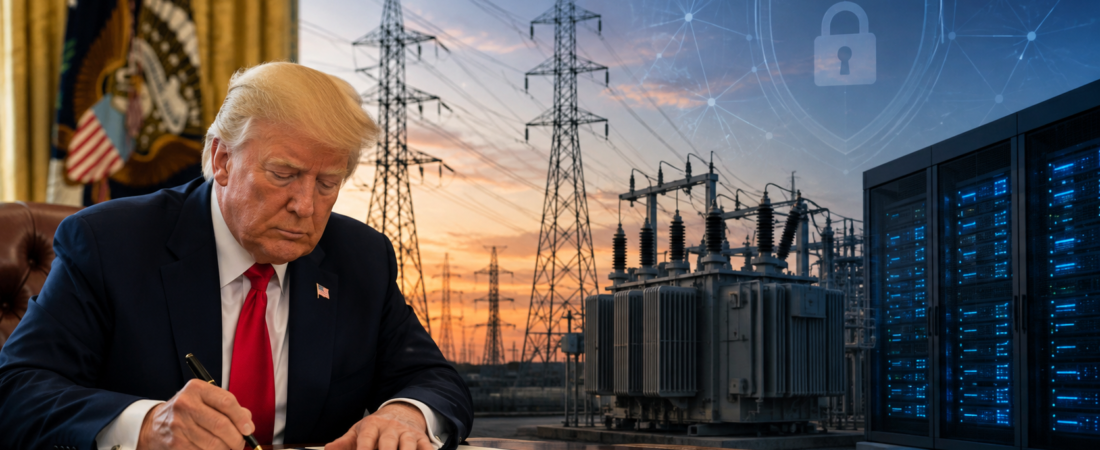
President Donald Trump signed an executive order declaring that foreign-supplied equipment used in the U.S. bulk-power system can pose an “unusual and extraordinary threat” to national security, the economy, and critical infrastructure.
The move is framed primarily as a cybersecurity and supply-chain action. But its consequences could reach much further.
Utilities may face new restrictions on what equipment they can buy. Existing foreign-made components could be subject to monitoring, isolation, replacement, or removal. Domestic manufacturers may gain new demand. And sectors with enormous electricity needs — especially AI data centers and advanced manufacturing — could face higher infrastructure costs if the transition makes grid equipment more expensive or harder to source.
The immediate question is not whether Americans will suddenly see their lights go out.
It is whether a national-security policy designed to make the grid safer also makes it more expensive to build and expand.
What the order actually does
The executive order gives the Energy Department broad authority to identify foreign-produced bulk-power equipment that may create unacceptable cybersecurity, sabotage, supply-chain, or national-security risks.
That can include not just physical equipment but associated software and digital capabilities.
If the Energy Secretary determines that equipment presents an unacceptable risk, the government can impose conditions on its use or require steps such as identifying, isolating, monitoring, securing, disconnecting, replacing, or removing it.
The order also directs federal officials to identify risky equipment connected to foreign entities and develop recommendations for how those items should be tracked or replaced.
That is a significant shift.
Instead of treating grid security mainly as a technical or regulatory problem, the administration is treating parts of the power-equipment supply chain as a national-security issue.
Why the White House says this is urgent
The administration argues that the U.S. grid has become more vulnerable for two reasons.
First, foreign-made equipment can create cybersecurity risks. The executive order warns that some equipment may contain digital backdoors or other vulnerabilities that could allow unauthorized remote access.
Second, the U.S. is becoming more dependent on electricity at the same time that parts of the grid rely on equipment sourced internationally.
The White House specifically points to the rapid growth of:
- data centers;
- artificial intelligence;
- advanced manufacturing;
- and defense production.
All of those sectors require large amounts of reliable electricity.
That means the consequences of a major grid disruption are potentially larger than they were a decade ago.
Who could benefit
The clearest potential winners are U.S.-based manufacturers of transformers, control systems, grid software, switchgear, and other critical electrical equipment.
If federal rules restrict certain foreign suppliers, utilities and developers may be pushed toward domestic alternatives.
That could create stronger demand for American manufacturers and encourage companies to expand production capacity in the United States.
Cybersecurity companies could also benefit.
Utilities may need more monitoring, testing, software audits, and security services to prove that existing equipment is safe or to comply with new federal requirements.
There is also a broader industrial-policy angle.
The more Washington treats grid equipment as strategic infrastructure, the more likely it becomes that federal procurement, tax policy, or future legislation will favor domestic production.
Who could face higher costs
Utilities are likely to be the first place where costs show up.
Replacing or restricting existing equipment is not cheap.
Large transformers and other grid components can be expensive, difficult to source, and slow to manufacture. If utilities are told to replace equipment before secure alternatives are readily available, projects could become more expensive or take longer.
Those costs do not necessarily stay with utilities.
They can eventually flow into:
- electricity rates;
- new data-center connection costs;
- industrial power contracts;
- and the cost of building new generation and transmission infrastructure.
That does not mean household electricity bills are guaranteed to rise because of this order.
The real effect will depend on how aggressively the Energy Department uses its authority, which foreign suppliers are targeted, how much existing equipment is affected, and whether domestic manufacturers can expand quickly enough to fill the gap.
Why AI is part of this story
The timing is especially important for the AI industry.
AI companies are building or planning increasingly large data centers, and those facilities require huge amounts of electricity.
That has already turned power access into a strategic issue for technology companies.
If grid equipment becomes more expensive or harder to source, the cost of connecting new data centers to the grid could rise.
On the other hand, stronger domestic supply chains could reduce long-term vulnerability and make future grid expansion more resilient.
So for AI companies, this is not simply a negative story.
The short-term risk is higher cost and slower deployment.
The long-term potential benefit is a more secure and reliable power system.
The political consequence
The executive order also gives Republicans a national-security argument around energy infrastructure.
Trump can frame the move as an effort to reduce dependence on foreign suppliers and protect critical U.S. systems from cyberattack or sabotage.
Critics, however, may argue that broad restrictions could increase costs, disrupt utility planning, or give the executive branch too much discretion over private infrastructure.
That debate could become more politically important if utilities begin warning about price increases or delays.
With the 2026 midterms approaching, anything that affects electricity costs, AI investment, manufacturing, or infrastructure can quickly become part of the broader economic argument between the parties.
What happens next
The executive order itself does not tell utilities to rip out specific equipment immediately.
The next stage is implementation.
Federal agencies must identify which equipment or suppliers pose unacceptable risks and decide what conditions, restrictions, or replacement requirements to impose.
That process will determine whether this becomes a narrow cybersecurity measure or a much broader reshaping of the U.S. grid-equipment market.
There are three things to watch.
First, which foreign suppliers are actually targeted.
Second, how much existing equipment is affected.
Third, whether domestic manufacturers can increase production quickly enough to avoid shortages and price pressure.
That is where the real economic consequences will emerge.
For now, the national-security case is clear: Washington wants tighter control over the hardware and software that keep the American grid running.
The unresolved question is how much that security will cost — and who ultimately pays for it.