A fast-moving legal fight over President Donald Trump’s push to tighten mail voting has created a new round of uncertainty just months before the 2026 midterm elections.
For a few hours Thursday, one of the biggest changes to federal mail-in voting procedures in years appeared to be taking effect.
The U.S. Postal Service said new requirements governing mail ballots were in force, following a Supreme Court decision earlier in the week that lifted a lower-court injunction against parts of President Donald Trump’s elections executive order.
Then the situation changed again.
U.S. District Judge Indira Talwani issued a temporary restraining order Thursday evening blocking core provisions of the Postal Service rule while she considers whether to impose a longer-lasting injunction. A hearing is scheduled for September 3.
For voters and state election officials, the immediate takeaway is simple: the new federal mail-ballot requirements are not on a clear path to implementation yet.
The larger consequence is more important. With the November midterms approaching, the rules governing how millions of Americans vote by mail are now caught in an unusually fast-moving fight among the White House, federal agencies, states and the courts.
What the new rules would do
Trump signed an executive order in March directing federal agencies to pursue several changes to election administration.
Among other provisions, the order directed the Department of Homeland Security to develop citizenship lists for states, instructed the Justice Department to prioritize investigations involving ballots issued to ineligible voters, and told the Postal Service to begin rulemaking involving new requirements for mailed ballots. The Supreme Court noted that one proposed requirement involved unique barcodes on ballot envelopes.
The Postal Service later finalized a much more detailed rule.
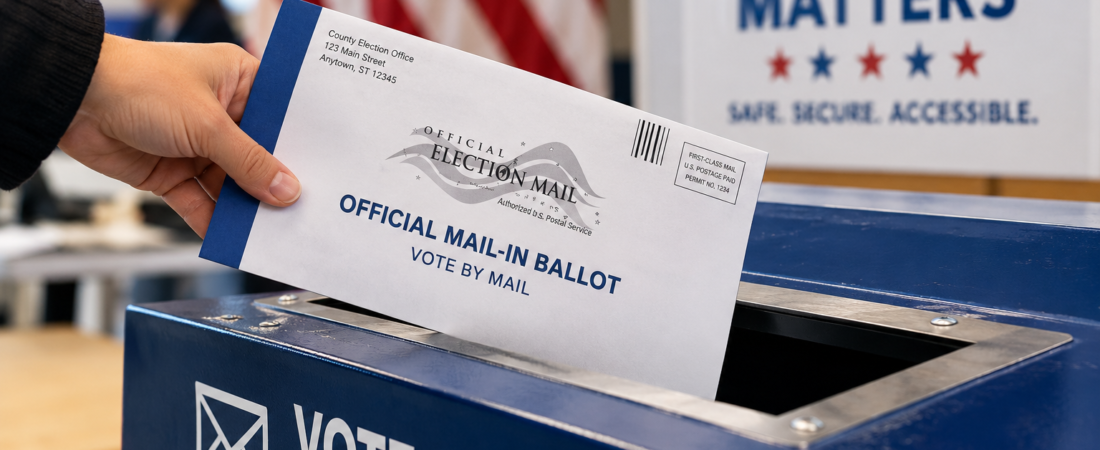
Under that rule, states would have to provide USPS with lists of people receiving mail ballots. Outbound and return ballot envelopes would need unique barcodes, and USPS could refuse to deliver ballots that failed to meet the new standards or were associated with voters not appearing on the required lists.
Those are not minor administrative changes.
Election offices could potentially need new envelopes, equipment, databases and procedures — all while preparations for the midterms are already underway.
What the Supreme Court actually decided
The Supreme Court’s August 24 ruling was a significant victory for the Trump administration, but it is important not to overstate what the Court decided.
The Court did not rule that Trump’s mail-voting policies are constitutional.
Instead, the majority concluded that the states challenging the executive order had not shown the kind of concrete injury necessary for the lower court to block the federal government from trying to implement parts of it at that stage of the litigation.
The Court explicitly said its decision did not mean that whatever the government eventually did to implement the order would necessarily be lawful.
That distinction turned out to matter almost immediately.
Once USPS moved from a presidential directive to an actual enforceable rule, states and voting-rights groups renewed their challenges. Talwani’s new temporary order now blocks core parts of that rule while the court examines those arguments.
So the Supreme Court opened a door for implementation — it did not settle the legal fight.
Why the timing matters
Mail voting is not a niche part of American elections.
All 50 states allow some form of mail voting. Twenty-nine allow voters to request a mail ballot without providing a specific excuse, while eight conduct elections entirely by mail. USPS says it processed nearly 100 million ballots during the 2024 election, and roughly 30% of voters nationwide cast ballots by mail.
That scale makes late rule changes particularly consequential.
State election officials do not simply flip a switch when a new requirement arrives. They may need to alter ballot-envelope designs, update voter databases, procure equipment, train staff and communicate new procedures to voters.
The states challenging the USPS rule argue that requiring those changes this close to an election could create administrative problems and potentially lead to eligible ballots being delayed or rejected. The Trump administration and USPS have argued that tighter procedures can improve verification and tracking of mail ballots.
Those competing claims are now at the heart of the case.
What this could mean for the midterms
The most immediate political consequence may not be that one party automatically gains an advantage.
It is uncertainty.
If the courts ultimately allow the USPS rule to take effect, states could face a compressed timeline to comply before ballots begin moving through the mail.
If the rule remains blocked, states will largely continue operating under their existing systems while the litigation proceeds.
A third possibility is a patchwork outcome in which different courts, states or provisions are treated differently.
That scenario could be the most complicated of all, because voters may encounter different rules depending on where they live and when court decisions are issued.
There is also an obvious strategic dimension. Republicans have generally pushed for tighter voting rules, arguing that additional safeguards strengthen election integrity. Democrats and voting-rights organizations have argued that many of those changes unnecessarily burden lawful voters and state election administrators.
But predicting which party would gain electorally from any specific rule change is much harder. Voting methods, state laws and voter behavior vary substantially across the country.
What voters should do now
For most voters, the practical advice is not to react to every court ruling by assuming their own voting procedure has changed.
Election administration remains largely state- and locally managed, and the federal litigation is still moving.
Voters planning to cast ballots by mail should rely on instructions from their state or local election authority and pay particular attention to deadlines and any updated ballot-mailing guidance as November approaches.
The situation could change again quickly.
Talwani’s temporary restraining order remains in place while she considers whether to issue a preliminary injunction, with a hearing scheduled for September 3. Additional appeals are also possible.
What happens next
There are three things to watch.
First, the September 3 hearing will determine whether the current temporary block becomes a longer-lasting preliminary injunction.
Second, the administration can continue appealing adverse rulings, potentially sending parts of the dispute back toward the Supreme Court.
Third, the calendar itself becomes increasingly important. Every week that passes reduces the amount of time states have to redesign or implement election procedures before November.
That may ultimately be the biggest consequence of this fight.
The question is no longer simply whether the federal government has the authority to impose new mail-voting requirements. It is whether any legally permissible changes can be implemented without creating new disruption in an election that is already underway.
And for voters, election officials and both political parties, that means the rules surrounding mail voting may remain unsettled until uncomfortably close to Election Day.